AI Financial Copilots: Automate Your Wealth & Master Your Money

Introduction
Remember the days of manually entering expenses into a spreadsheet, spending hours trying to balance a budget, and feeling a constant low-level anxiety about your financial future? For many of us, managing money feels like navigating a dense fog without a map or a compass. It’s overwhelming, time-consuming, and it’s easy to feel like you’re always a step behind.
But what if you had a brilliant, data-driven partner working for you 24/7? A copilot dedicated to your financial well-being, capable of analyzing your spending, optimizing your investments, and mapping out the clearest path to your goals. This isn’t science fiction; it’s the reality of AI financial copilots.
This new wave of personal finance technology is fundamentally changing our relationship with money. By leveraging the power of artificial intelligence, these tools are making sophisticated wealth automation and smart financial planning accessible to everyone, not just the ultra-wealthy.
In this comprehensive guide, we’ll demystify the world of AI financial assistants. You’ll learn exactly what they are, how they can help you automate wealth, the core features that power everything from budgeting to investing, and how to choose a secure and effective platform to begin your journey toward true ai money mastery.
Beyond Spreadsheets: What Exactly is an AI Financial Copilot?
An AI financial copilot is an intelligent software platform that acts as your personal financial assistant. It goes far beyond simple budgeting apps that just track where your money went. Instead, it uses artificial intelligence, machine learning, and predictive analytics to provide custom financial insights, automate complex tasks, and guide you toward better financial decisions.
Think of it as the evolution of money management:
- Manual Era: Pen, paper, and spreadsheets. Labor-intensive and reactive.
- App Era: Mint, YNAB, and others. Digitized tracking and categorization. A huge step forward, but still largely reliant on user input and review.
- Copilot Era: The age of money management AI. These systems are proactive, predictive, and personalized. They don’t just show you the data; they interpret it, find hidden opportunities, and can even take action on your behalf.
This leap is powered by a few key technologies:
- Machine Learning (ML): AI copilots learn your unique spending habits, income patterns, and financial goals over time. The more data they have, the smarter and more personalized their recommendations become.
- Predictive Analytics: By analyzing past behavior and market data, these tools can forecast future cash flow, identify potential budget shortfalls, and model the long-term growth of your investments. This is the core of predictive financial ai.
- Natural Language Processing (NLP): Many copilots feature conversational interfaces, allowing you to ask questions in plain English like, “How much did I spend on dining out last month?” or “Can I afford a $2,000 vacation in July?”
Essentially, an AI financial copilot is like having a data scientist, a financial planner, and a meticulous bookkeeper all rolled into one accessible app.
The Core Pillars of AI-Powered Wealth Automation
A true financial copilot offers a holistic view of your finances, integrating multiple aspects of your money into a single, intelligent ecosystem. Here are the key functions that enable comprehensive wealth automation.
Smart Financial Planning & Budgeting, Reimagined
This is often the entry point for most users. Traditional budgeting is tedious. You set categories, you track spending, and you feel guilty when you overspend. AI budgeting tools flip this model on its head.
Instead of just tracking, they analyze. An AI can automatically categorize 99% of your transactions with stunning accuracy, identify wasteful subscriptions you forgot about, and show you exactly where your money is flowing. The real power lies in the custom financial insights. Your copilot might notice you consistently overspend on groceries in the third week of the month and suggest a different shopping schedule or bulk buying to save money. It transforms your budget from a restrictive document into a dynamic plan for achieving your goals.

These platforms provide a clear, real-time ai spending tracker that visualizes your financial health, making it easier than ever to make informed, on-the-spot decisions. Related: Gen Z’s Guide to Building Wealth, which explores modern approaches to financial growth.
Intelligent Investing & AI-Powered Portfolios
For years, sophisticated investing was gated behind high fees and human advisors. Robo-advisors 2024 and other ai investment platforms have democratized the process, and today’s versions are more powerful than ever.
These platforms use algorithms to build and manage diversified portfolios based on your specific risk tolerance and time horizon. This is where ai investing strategies shine. An AI can:
- Automate Deposits: Set up recurring investments without lifting a finger.
- Rebalance Portfolios: Automatically adjust your asset allocation to keep it aligned with your goals as market conditions change.
- Harvest Tax Losses: Strategically sell losing investments to offset gains, potentially lowering your tax bill—a complex strategy made simple through automation.
Whether you’re a seasoned trader or a complete beginner, ai for investors provides the tools to build ai powered portfolios that work towards your ai wealth growth goals systematically and without emotion. For more on this topic, check out Related: The Future of Your Money: Top FinTech Innovations for Investors.
Proactive Debt & Savings Management
Getting out of debt and building savings are two sides of the same coin. AI savings apps and ai debt management tools work in tandem to optimize your cash flow for both.
An AI copilot can analyze all your debts—credit cards, student loans, car payments—and calculate the most effective repayment strategy. It might recommend the “Avalanche” method (paying off high-interest debt first) or the “Snowball” method (paying off small debts first for psychological wins) based on your unique situation.
Simultaneously, it can identify opportunities to save. Many apps use “round-up” features to save your spare change or employ algorithms to analyze your cash flow and automatically transfer small, safe amounts into a savings account. This automates the discipline required for building an emergency fund or saving for a down payment, a key step towards financial independence ai.
Future-Proofing Your Goals: AI Retirement and Tax Planning
Long-term goals like retirement can feel abstract and distant. AI retirement planning makes them tangible. By modeling thousands of potential market scenarios, an AI can project your retirement readiness, show you the impact of increasing your contributions by just 1%, and adjust its recommendations as your life changes.
Similarly, ai tax planning is becoming a game-changer. Instead of scrambling in April, an AI can provide year-round insights. It can identify tax-deductible expenses you might have missed, suggest contributions to tax-advantaged accounts like a 401(k) or IRA, and help you understand the tax implications of your investment decisions in real-time.
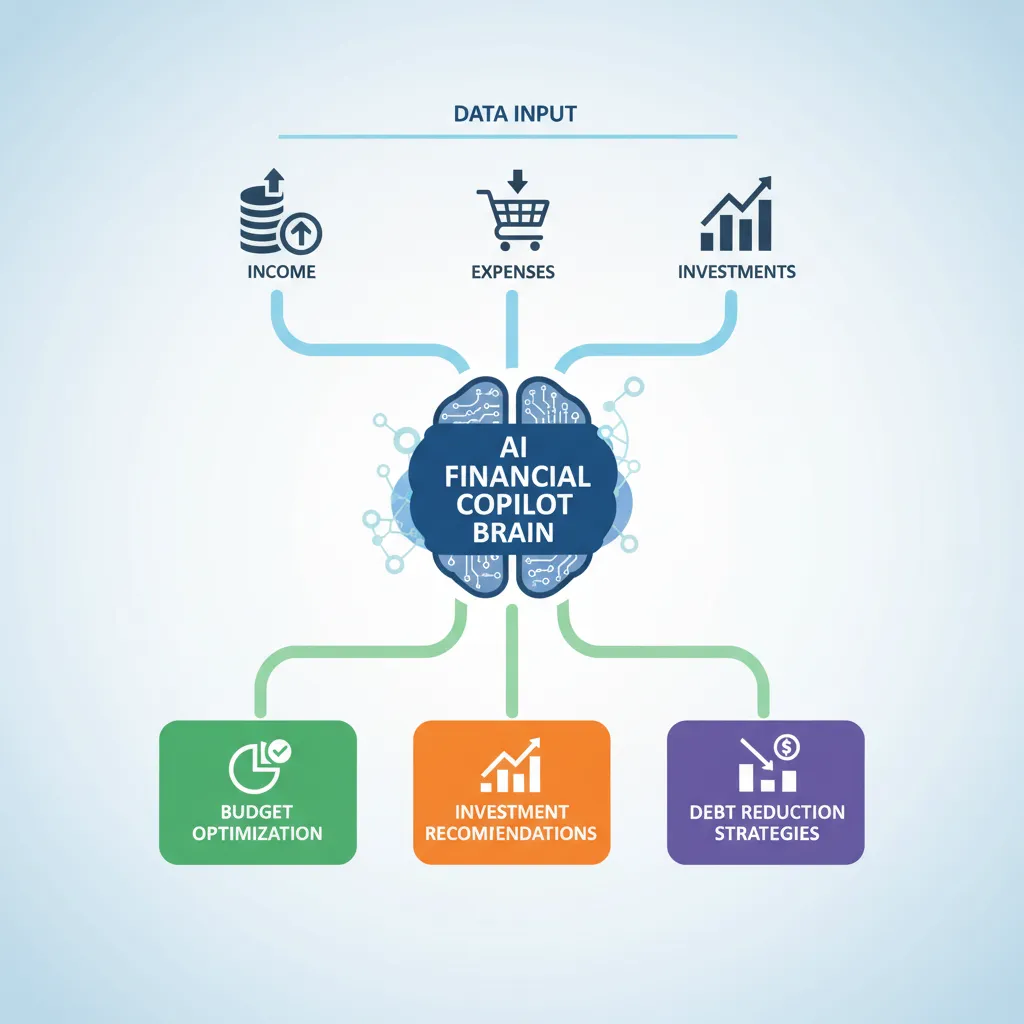
How AI Financial Assistants Actually Work: The Tech Unpacked
It all sounds great, but how does it work? And more importantly, is it safe?
The foundation of any ai financial assistant is secure data aggregation. Using trusted third-party services like Plaid, you grant the app read-only access to your financial accounts—checking, savings, credit cards, loans, and investments. This data is encrypted both in transit and at rest, using the same security protocols as major banks. This is the cornerstone of secure ai finance.
Once the data is connected, the AI engine gets to work:
- Data Normalization: It cleans up and categorizes messy transaction data into a universal format.
- Pattern Recognition: The machine learning models begin to identify your personal financial DNA—your pay cycle, recurring bills, discretionary spending habits, and savings rate.
- Insight Generation: The AI compares your patterns to your stated goals and to anonymized data from similar users, identifying opportunities and risks. It might flag an unusually high utility bill or celebrate a week of on-budget spending.
- Action & Automation: Based on rules you set, the copilot can then automate tasks like transferring money to savings, paying down a credit card, or investing a cash surplus.
The entire process is designed to reduce the mental load of managing money, moving you from a state of financial stress to one of clarity and control.

The collaborative nature of these tools is key, aligning with the broader trend of Related: Human-AI Synergy: The Future of Work and Productivity. You are the pilot; the AI is the incredibly smart copilot handling the complex calculations so you can focus on the destination.
Choosing Your Copilot: What to Look for in an AI Finance Tool
The market for ai personal finance apps is growing rapidly. When evaluating your options, consider these crucial factors:
- Security & Privacy: This is non-negotiable. Look for bank-level 256-bit AES encryption, multi-factor authentication (MFA), and a clear privacy policy that explains how your data is used.
- Comprehensive Integration: The best tools can connect to all your financial accounts to give you a complete 360-degree view of your net worth.
- Holistic Features: Does the platform cover the areas you need most? Some excel at budgeting, while others are focused on investing or debt. A true copilot aims to integrate all of them.
- Personalization and Goal Setting: You should be able to set and track multiple, custom goals (e.g., “Save for a house,” “Pay off student loan by 2028”). The AI’s advice should be tailored to these goals.
- User Experience (UX): A cluttered or confusing interface defeats the purpose. The app should present complex information in a simple, intuitive, and actionable way.
- Cost & Fee Structure: Understand how the service makes money. Is it a flat monthly subscription? A percentage of assets under management (AUM)? Or a freemium model? Ensure the value provided justifies the cost.
The Future of Finance AI: What’s on the Horizon?
We are only at the beginning of the future of finance ai. The technology is evolving at an exponential rate, and the next generation of financial copilots will be even more integrated and intelligent.
We can expect to see:
- Hyper-Personalization: AI that understands your life events. It will know you’re getting married and will proactively suggest ways to merge finances. It will see you have a child and will automatically open a conversation about college savings plans.
- Enhanced Predictive Advice: AI will move from suggesting actions to predicting needs. It might warn you of an impending cash crunch two weeks before it happens or advise you on the optimal time to refinance your mortgage based on interest rate forecasts.
- Deeper Integrations: Your financial copilot will connect with other parts of your digital life, from your calendar to your health apps, providing truly holistic life advice. It may even touch on complex assets like ai real estate investing.
- AI for Financial Literacy: The best copilots will not only manage your money but also teach you about it. Through interactive lessons and explainable AI, they will improve users’ financial literacy, creating a more educated and empowered population. This ties into the potential of more powerful, localized AI models, a concept explored in Related: Edge AI Explained: Powering Smart Devices with Real-Time Intelligence.

Conclusion
The days of feeling adrift in a sea of financial complexity are numbered. AI financial copilots represent a paradigm shift, moving us from reactive record-keeping to proactive, automated wealth-building. They are powerful tools designed to optimize money with ai, providing the clarity, discipline, and strategic insight needed to navigate the modern economy.
By handling the tedious calculations and providing data-driven guidance, these assistants free up your most valuable asset: your time and mental energy. You can focus on living your life, confident that your copilot is working tirelessly in the background to turn your financial goals into your financial reality.
The journey to money mastery is no longer one you have to take alone. Are you ready to take control and automate your wealth? The future of personal finance is here, and it’s time to put it to work for you.
Frequently Asked Questions (FAQs)
Q1. What is an AI financial copilot?
An AI financial copilot is a sophisticated application that uses artificial intelligence to help you manage your entire financial life. It connects to your bank accounts, credit cards, and investments to automate budgeting, track spending, optimize investments, and provide personalized financial advice and insights.
Q2. How do AI budgeting tools work?
AI budgeting tools work by securely connecting to your financial accounts to automatically download and categorize your transactions. Using machine learning, they analyze your spending habits, identify trends, predict future expenses, and provide custom insights to help you save money and stick to your financial goals without manual data entry.
Q3. Are AI financial assistants safe to use?
Reputable AI financial assistants use bank-level security measures, including 256-bit AES encryption and multi-factor authentication, to protect your data. They typically have read-only access to your accounts, meaning they cannot move money without your permission. Always choose well-known providers and review their security and privacy policies.
Q4. Can AI replace a human financial advisor?
AI financial copilots excel at data analysis, automation, and managing straightforward investment portfolios. They are a powerful tool for most people’s day-to-day financial management. However, for complex situations like estate planning, intricate tax strategies, or nuanced life events, a human financial advisor can provide personalized empathy, judgment, and holistic advice that AI currently cannot. Many people use both in a hybrid approach.
Q5. What’s the difference between a robo-advisor and an AI financial copilot?
A robo-advisor is primarily focused on one thing: automating investing. It builds and manages an investment portfolio for you. An AI financial copilot is much broader; it’s a holistic platform that often includes robo-advisory features but also integrates smart budgeting, debt management, savings goals, and cash flow analysis into a single view.
Q6. How can AI help with debt management?
AI can significantly accelerate debt repayment by analyzing all your outstanding loans and credit card balances. It then calculates the most efficient payoff strategy (like the avalanche or snowball method) based on interest rates and your financial situation. It can also identify extra cash in your budget that can be automatically applied to your debt, helping you get out of debt faster.
Q7. What are the first steps to using AI for personal finance?
The first step is to research and choose a reputable AI financial copilot app that aligns with your goals. Once selected, you’ll need to download the app, create an account, and securely link your financial accounts (checking, savings, credit cards, loans). The AI will then begin analyzing your data and providing initial insights, usually within a few minutes.